|
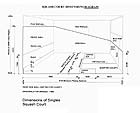
The standard court in softball singles
is 9.75 m (32 ft) in length and 6.40 m
(21 ft) in width. A service-court line
is painted across the court 4.26 m (14
ft) from the back wall, behind which a
serve must land. A painted line from the
back wall to the service-court line creates
two equally sized service areas. On each
side of the court is a square service
box 1.60 m (5 ft 3 in) long and wide.
While in the process of serving, a player
must keep one foot in the box. A service
line 1.82 m (6 ft) from the floor is painted
on the front wall. Serves must hit the
front wall above this line. The telltale-a
narrow metal box that makes a loud sound
when the ball hits it-rises on the front
wall from the floor to 480 mm (19 in)
in height. Shots hitting the telltale
are out of play.
 During
play, the ball must stay within boundary
lines marked on the front, side, and back
walls. The front wall line is 4.57 m (15
ft) high. The back wall line is 2.13 m
(7 ft) high. Along each side wall, a line
drops in a diagonal slope from the front
wall. It meets with the back wall line
in the back corner. Shots hitting above
these lines, including the ceiling, are
out of play. During
play, the ball must stay within boundary
lines marked on the front, side, and back
walls. The front wall line is 4.57 m (15
ft) high. The back wall line is 2.13 m
(7 ft) high. Along each side wall, a line
drops in a diagonal slope from the front
wall. It meets with the back wall line
in the back corner. Shots hitting above
these lines, including the ceiling, are
out of play.
The hardball version of the game is played
on a court similar to that in the softball
version. The major differences are that
the hardball court is 0.8 m (2.5 ft) narrower,
the front wall is 0.3 m (1 ft) higher,
and the telltale is 432 mm (17 in) in
height. Another major difference is the
side wall line.
 On
a hardball court each side wall line extends
from the front wall toward the back of
the court at a height of 4.88 m (16 ft).
At the service-court line, the side wall
line drops at a 90 degree angle to 3.66
m (12 ft) and then continues at this height
to the back corner. There it meets the
back wall line. Doubles courts in both
softball and hardball are usually larger
than those used in singles games. On
a hardball court each side wall line extends
from the front wall toward the back of
the court at a height of 4.88 m (16 ft).
At the service-court line, the side wall
line drops at a 90 degree angle to 3.66
m (12 ft) and then continues at this height
to the back corner. There it meets the
back wall line. Doubles courts in both
softball and hardball are usually larger
than those used in singles games.
|